Need more help with Latin verbs? These videos cover conjugations with different tenses and voices.
Aulas do Curso
(66 vídeos)
0 de 66 aulas concluídas
0%
Progresso salvo somente neste navegador.
0
A Theory of Tenses
What are tenses actually? This video covers the basic foundation of what makes up a tense, and relates it to the study …
1
The Present Tense
Seize the day and learn how to conjugate your Latin verb in the present tense. This video covers the present conjugatio…
2
The Imperfect Tense
One of the most important and common of the tenses in Latin, the Imperfect Tense is more or less easy to recognize and f…
3
The Future Tense
The future is easy to understand, and a bit tricky to form, since it has a different approach for first and second conju…
4
The Perfect Tense
Latin's Perfect Tense is as regular as a high-fiber diet. This video investigates the way to form this tense, which is …
5
The Pluperfect Tense
"Pluperfect" is a great pick up line: more than perfect. This video covers how Latin uses this "more than perfect" tens…
6
The Future Perfect Tense
The Future Perfect Tense is the least used tense in Latin, but it's meaning and formation are quite logical. This video…
7
The Passive Voice in English
What's the passive voice, and why would you even want to use it? After all, Microsoft Word thinks it's bad. This video…
8
The Passive Voice in Latin
Turning an active sentence into Latin is easy, sort of. The active-accusative becomes the passive-nominative, and the ac…
9
The Present Passive
The present passive may be tough to understand, but its formation if pretty simple. Instead of the active endings (-o/m…
10
The Imperfect Passive
If you know the imperfect active, then the passive will be a cinch. All you need to do is trade the active endings for …
11
The Perfect Passive
This video is entirely a "has been" as we explore the passive voice of the perfect tense. Finally, we use the fourth an…
12
The Pluperfect Passive
The passive voice of the pluperfect tense seems to be a careful combination of the perfect passive and the pluperfect ac…
13
The Future Perfect Passive
By the end of this video, you will have been taught the future perfect passive. This tense formation as similar to the …
14
The Future Passive
The future passive may not be the most popular, or even the easiest, of all the tenses, but that shouldn't diminish its …
15
Imperatives
Commands are a part of life, especially for a teacher. Watch this video! Like this video! Visit our site! Learn Lati…
16
An Overview of the Subjunctive
The subjunctive mood can be very difficult to understand, even in Latin with its systematic approach to grammar. I try …
17
The Present Active Subjunctive
Let's learn how to conjugate a verb in the present active subjunctive. It's as easy as "we fear a liar" or "Wendy wears…
18
The Perfect Active Subjunctive
The Perfect Active Subjunctive is an easy combination of the perfect stem, the infix -eri-, and the personal endings. B…
19
The Pluperfect Active Subjunctive
The pluperfect subjunctive is similar to the pluperfect indicative, only instead of using as your endings the imperfect …
20
The Present Passive Subjunctive
The present passive subjunctive is very similar to the present active subjunctive. You still have your vowel shift (We …
21
The Imperfect Passive Subjunctive
The conjugation of verbs into the imperfect passive subjunctive is just as easy as into the imperfect active subjunctive…
22
The Perfect Passive Subjunctive
The conjugation of a verb in the perfect passive subjunctive requires just a small change from the indicative mood of th…
23
The Pluperfect Passive Subjunctive
The pluperfect passive subjunctive is linked to the indicative conjugation of the pluperfect - swap out the imperfect in…
24
Irregular Verbs: sum, esse
The irregular verb sum, esse, is Latin's most important verb (not to mention the most common word in the entire language…
25
Third Person Plural
This video shows how you can turn a sentence with a third person singular verb into one with a third person plural verb.…
26
Irregular Verbs: possum, posse
The irregular verb possum, posse, is related to that other big irregular verb, sum, esse. Which means that learning how …
27
An Introduction to the Latin Infinitive
You see infinitives everywhere in Latin, from the second principal part of a verb's dictionary entry to sentences with p…
28
Participles in Latin
The participle in Latin is exceptionally important, even more so than it is in English. This video reviews the four part…
29
Present Participles
The Latin present participle puts the NT in present. This video covers the formation and use of the present participle.…
30
The Imperfect Active Subjunctive
This is the easiest of all Latin conjugations: take the 2nd principal part and just add your personal endings. No ifs,…
31
Principal Parts Supine Version
Everyone hates them, but you can't do the Latin verb without them - they are the principal parts. Sure, it seems like t…
32
Principal Parts Participle Version
Everyone hates them, but you can't do the Latin verb without them - they are the principal parts. Sure, it seems like t…
33
Basic Latin Word Order
Latin sentences tend to have an order different from what most English speakers are familiar with. Latin likes a touch …
34
The Singular of the Present Tense
Not all verbs end in -t, and as you move from the first to second to third person, the ending changes with the subject. …
35
The Subjectless Verb
Latin, like some of its modern daughter languages, doesn't often require a subject in the sentence if it is obvious in c…
36
Perfect Passive Participles
The perfect passive participle is the fourth principal part of the Latin verb. This video covers the formation and use o…
37
Future Active Participles
The future active participle puts the U R in future. You will also find that this participle is used in the active perip…
38
Supines in Latin
The supines are an amazing to say bit of complex grammar. It is a strange fourth declension verbal noun only found in tw…
39
Rule 9: Subject Verb Agreement
The basis of verb conjugation in Latin comes down to its subject. Is it first person, second person, or third person, an…
40
Rule 10: What Adverbs Modify
Adverbs in Latin and English do more than just modify verbs (although that is where you will see them mostly). An adverb…
41
Rule 13: The Nominative Case
We save maybe the most basic rule of them all for lucky number 13 - the noun that controls the verb (also known as the s…
42
Rule 26: Dative with Special Verbs
When is the verb's object not in the accusative case? When it's a special verb! (Then it's in the dative case) This vide…
43
Rule 25: The Dative of Indirect Object
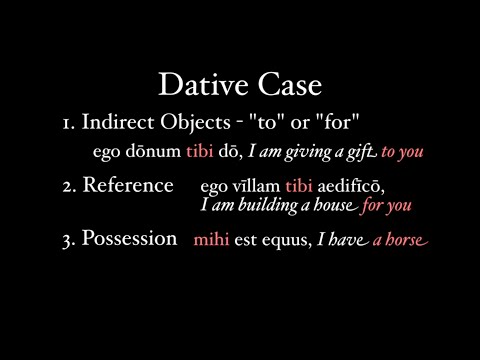
Perhaps the simplest and most important use of the dative is the indirect object - this is the dative that's used with v…
44
Rule 27: The Dative with Compounds
A long time ago when I was in college, my professor noticed that I had trouble with compound verbs that take the dative,…
45
Rule 49: The Ablative with opus and u¯sus
Similar to the previous rule with utor and the other PUFF-V deponents, the words opus and usus, when they signify need, …
46
Rule 57: The Ablative Absolute
The ablative absolute is arguably the most important bit of complex grammar in Latin. It combines cases with participles…
47
Adverbs in Latin
The adverb is one of the main parts of speech in both English and Latin, and the similarity doesn't stop there. In both …
48
Rule 61: The Jussive Subjunctive
The jussive subjunctive, also known as the hortatory, is commonly understood as an urging, or gentle command. Let us exp…
49
Rule 62: The Optative Subjunctive
This video continues our look at some of the independent uses of the subjunctive. The optative subjunctive is used when …
50
Rule 64: The Potential Subjunctive
We wrap up the final of four uses of the subjunctive in the main clause with the potential subjunctive. This is used whe…
51
Rule 65: Commands in Latin
The imperative mood is used for issuing commands in Latin. This video covers the basic formation of the imperative, whil…
52
Rule 66: Negative Commands
In the last rule, we looked at how we form the imperative mood in Latin. But what about prohibitions or negative command…
53
Rule 67: The Infinitive as a Subject
In Latin, the infinitive is used in several different ways. In this video, I will discuss how the infinitive can be used…
54
Rule 68: The Complementary Infinitive
In Latin there are a set of verbs that aren't complete just by themselves. Claudia potest, "Claudia is able," needs some…
55
Rule 69: The Infinitive in Indirect Statement
Indirect discourse (or more specifically indirect statement) is a hugely important topic in Latin, and a complicated one…
56
Rule 70: The Historical Infinitive
The infinitive, which often has its subject in the accusative case, can take a nominative subject in place of an imperfe…
57
Rule 71: Sequence of Tenses
There are four tenses of the subjunctive (present, perfect, imperfect, pluperfect), but in any given sentence, you have …
58
Rule 72: The Relative Time of Participles
Participles in Latin have three tenses: present, perfect, and future. But these terms can be misleading, because they do…
59
Rule 73: Gerunds and Gerundives
We continue learning about verbal nouns and adjectives by exploring the use of gerunds and gerundives in the genitive, d…
60
Rule 74: The Accusative Supine
The supine is a fourth declension verbal noun that is almost entirely unique to Latin. We commonly see it as the fourth …
61
Future Passive Participles (Gerundives)
The future passive participle, also known as the gerundive, is used in the passive periphrastic in order to express obli…
62
Rule 82: Temporal Clauses
Temporal clauses are those that relate to time, and in Latin these clauses exclusively have a verb in the indicative moo…
63
Rule 83: Temporal cum Clauses
The conjunction cum can introduce temporal clauses when the verb in the clause is in the indicative mood. In other words…
64
Deponent Verbs
Verbs in Latin come in two different voices, the active and the passive. But then there's this other set of verbs that d…
65
A Few Thoughts on Voice in Latin
I ran across the following quote when preparing for my video on deponent verbs: "Active forms do not always convey activ…